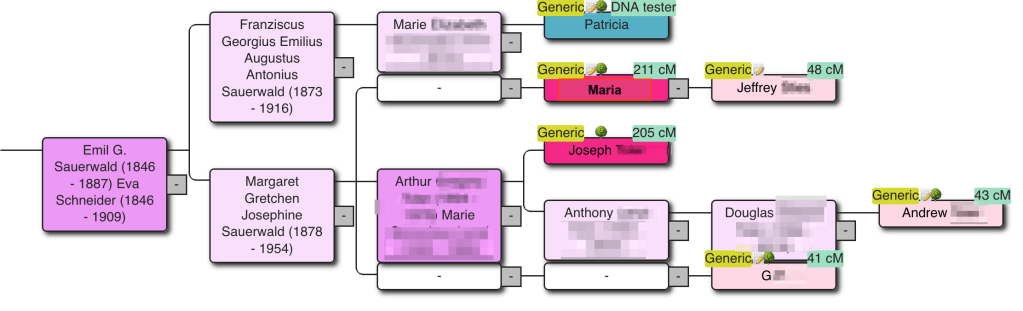
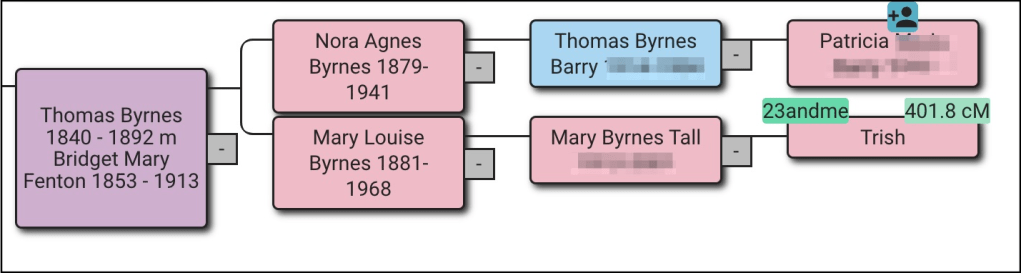
There are times when I think I don’t have a tree for a certain DNA match and will add one, only to discover that there was already a tree there. Especially if the tree was added automatically, and I can see how to add another generation or so to it. One way to check your trees and avoid having duplicate trees is to export the trees into Excel. At the bottom of the ‘Tree Management’ page is the selection.
Export trees to Excel.
In the Excel file sort into alphabetical order on ‘name’ in column A.
Excel list of trees from AutoLineage.
If you find a name appearing twice in the alphabetically list, it likely indicates that a tree has been added twice. One thing to be aware of here is when the match’s name is initials, as more than one match might have the same initials. I made a list of the duplicate names and initials and then went back to AutoLineage to look at the list of trees. Putting a name into the search field will show the duplicate trees and you can delete one of them. With the duplicate initials you can check if it’s one match listed twice or two different matches by checking the cM values. In the image below you can see that these are two different matches because of the different cM values.
Two matches with same initials.
This is a quick and easy way to make sure that you do not have duplicate trees in AutoLineage, which can cause problems when finding common ancestors.
Great news for AutoLineage users! You no longer have to use “Save Page As” to import your Ancestry matches and shared matches—there’s a faster way with simple copy and paste. Instead of saving files to your computer, you can now copy your match or shared match page in Ancestry and paste it directly into AutoLineage in another browser tab.
Log into AutoLineage, set up a profile, and select ‘Generic’ as the DNA test. Under Import Matches select ‘Copy Paste Wizard.
Select Copy Paste Wizard.
That brings up the Wizard.
Copy Paste Wizard
The Wizard can be used for Matches and Shared Matches. It will show the Existing Matches, and Existing Shared Matches. You will see these numbers change as you add matches and shared matches. After you select and copy your Ancestry data you add it to the Wizard with the blue ‘Paste Data’ button. The list of New Imported Matches or New Imported Matches will update.
Ancestry’s match page initially shows 20 matches. If you scroll to the bottom of that page, you can change that setting to 50 matches. To make things more efficient that number can be changed to 100 matches per page. At the top of the window is the URL for the match page and it says ‘ItemsPerPage=50’ That 50 can be changed to 100, which makes copying the match data twice as fast!
Match data set at 50 matches per page.
Changing that 50 to 100 makes copying the match data twice as fast!
After changing match collection to 100 matches per page.
‘Select All’ under the Edit menu, or Ctrl A in Windows, or Cmd A on Mac will highlight all the matches on the page.
With Dave’s 100 matches selected.
Select ‘Copy’ (Ctrl C or Cmd C) to copy all the data on the page and then ‘Paste’ it into the AutoLineage ‘Copy Paste Wizard.’
After pasting 100 matches into the Copy Paste Wizard.
You’ll notice both the ‘Total Imported Matches’ and the ‘New Imported Matches’ should 100. At this point you can ‘Save and Close Wizard’ or go back to the tab with Dave’s Match data and select another page of matches. If there are no (shared) matches appearing in the wizard, go back to the page and try to select and copy the data from the top of the page.
Next collect shared matches. Dave paternal Aunt Mary tested at Ancestry. She has 14 pages of shared matches. Each page can be selected, copied and added to the ‘Copy Paste Wizard.’
Shared matches added to the Copy Paste Wizard.
When shared matches are added to the Wizard, if a match hadn’t been collected before, the wizard adds that match to Dave’s matches as well. Four hundred of Dave’s matches had originally been added. The lowest cM for them was 25, but you’ll notice in the list of Mary’s shared matches several matches at 6 or 7 cM. The Wizard automatically adds these to Dave’s matches as well. Looking at ‘New Imported Matches’ shows there were 180 new matches that had values lower than cM that matched Dave and his Aunt Mary, that were added along with the shared matches.
Especially with Copy – Paste, it’s a good idea to backup the AutoLineage data after adding matches and shared matches. The backup option is at the bottom of the ‘DNA Test Overview’ page. This saves the data as a JSON file that can be loaded back into AutoLineage (under import matches).
Backup for matches and shared matches.
Once you have enough matches and shared matches you can run clustering. There are several new features in clustering.
Clustering Wizard
Unweighted clustering is the default cluster setting that AutoLineage (and Genetic Affairs in general) has always employed. Weighted clustering is a new way of clustering that considers the amount of DNA between shared matches. This first image is of Dave’s matches in an unweighted, dense cluster. The various lines of the family are labeled. You’ll notice the green, red, purple brown, and pink clusters have a lot of grey cells that connect to paternal Aunt Mary, and Dave’s full sister connects to the both the paternal and maternal clusters, as would be expected.
Unweighted, dense cluster of Dave’s data.
The graph images are clearer now too. This is the one for the unweighted cluster. You can clearly see how Dave’s sister connects their maternal and paternal matches and how all the paternal matches are connected to Aunt Mary.
Graph visualization for unweighted, dense cluster.
This next image is of the weighted, dense cluster of Dave’s data. In this cluster a lot more of Dave’s close family members are seen, and the paternal grandmother side splits into 2 clusters. The orange cluster’s most recent common ancestor (MRCA) are Dave’s paternal third great grandparents, while the green cluster MRCA are his paternal second great grandparents. Here again sisters and nieces have grey cells to both paternal and maternal matches.
Weighted, dense cluster.
When you have a cluster you can run the AutoKinship tool, which is able to reconstruct trees based on shared DNA (and optionally MRCA data). From viewing the clusters select ‘Matches’ at the top of the window. This brings up a list of the matches in the clusters, which you can download to Excel if you want. You can also select the cluster that you want to use for AutoKinship.
Matches list.
The brown cluster was selected for AutoKinship and again brings up the actual cluster.
Showing the brown cluster.
Clicking on ‘Matches’ again brings up the screen where you can select AutoKinship.
Setting up for AutoKinship.
The list shows that Dave will be included along with the people in cluster 5.
Ready to start AutoKinship.
You can choose to add known relationships, or provide generational information between matches, before running AutoKinship if you wish. Or import trees for the matches and search for common ancestors. Both known relationships and MRCA information will be integrated in the reconstructed trees. Five trees were generated. This one perfectly located the matches in their family relationship. The MRCA are Dave’s great grandparents, John Coleman and Mary Ann Duff.
An AutoKinship tree of the matches in the brown cluster.
Conclusion
The new Copy Paste Wizard is a real game-changer for AutoLineage users working with Ancestry data. No more saving pages or juggling multiple files ,with just a few quick copy-and-paste steps, you can bring in both your matches and shared matches directly into AutoLineage. It’s fast, simple, and surprisingly satisfying to watch those numbers update as new matches appear!
I tested the Wizard with my own Ancestry data and found it worked beautifully. Within minutes, I had all my matches imported, ready for clustering and AutoKinship analysis. The process felt seamless compared to the old ‘Save Page As’ method.
Combined with the new weighted clustering and improved visualization options, this streamlined workflow helps turn raw match data into clear, meaningful family patterns and reconstructed trees.
Often your research is focused on a specific part of your family line. This was the case with Mary who wanted to explain her father’s Collins line. Where had the Collins family lived in Ireland? When did the immigrate to the United States? And could we find more cousins on the Collins line? She had her DNA on Ancestry where we could select and study only her “Paternal” matches on her father’s Collins line. Mary’s family tree provided the surname of paternal grandmother, and great grandmothers that we’d want to avoid.
Mary’s tree from AutoLineage.
We started out by selected “Paternal” matches on her Ancestry DNA.
Selecting Mary’s paternal matches on her Ancestry DNA.
After scrolling down the page, we set the number of matches on the page to 50.
Setting for 50 matches per page.
Recently Paul Weaver had commented on the Genetic Affairs Facebook page how that number could be changed to a maximum of 100, by editing the number in the URL of the page.
Ancestry URL where you can change the 50 matches to 100.
We saved several pages of the close matches first.
Saving page 2 of Mary’s matches.
Next, we added the “Common Ancestor” filter, which is found at the top of the match list.
Filter to find matches that say “Common Ancestor.”
We saved the pages of matches that said Common Ancestor. We added CA for Common Ancestors to the filename to help keep track of what we had saved.A
Saving Mary’s common ancestor matches.
Since AutoLineage keeps track of the matches that have been added, there’s no worry of duplicating a match.
I make a list of the matches when I start looking at shared matches. I write down the match name, the number of pages of shared matches, notes and cM. This helps keep track of which matches I’ve seen and having the name there makes it easier to spell the name correctly on the gedcom when I save it. If the match is on the grandmother’s side, and not one that I’m saving I still write it down and add grandmother in the notes. This avoids having to look at that match again.
Excel worksheet that is printed and used to document matches viewed.
By looking at the Common Ancestors that Ancestry had found we could determine which matches we wanted to save based on Mary’s tree. If they were on the Collins line, we wanted their tree and their shared matches. First,we’d click on “Tree” and then “Expand Tree” using right click to have the expanded tree open in a new tab.
Elizabeth’s tree that will be expanded in a new tab.
Then on the match’s page we clicked on “Shared Matches.”
Shared matches selected.
While those are coming up, we’d go to the tab with the tree and save the gedcom using One2Tree in my Chrome extension.
Elizabeth’s tree that will be saved to a gedcom.Gedcom in One2Tree.
After the gedcom is saved to the Download folder, we rename it with the match’s name, copy the name and add the gedcom to Mary’s gedcom folder.
Saving Elizabeth’s tree.
By then the shared matches were up. We’d sort the shared matches to show the closest match to this shared match.
Sorting shared matches to show Elizabeth’s closest matches.
Often that would give hints to the family relationship. Elizabeth’s closest matches are first cousins once removed, but often there are siblings or nieces and nephews which provide a lot of information for connecting the family trees.
Elizabeth’s closest matches.
Next, we’d scroll to the bottom of the page and record to the number of pages of shared matches on my list.
Number of pages of shared marches for Elizabeth.
Here Elizabeth only has one page of shared matches. Using Command S on Mac (Control S on Windows) and we saved the first page of shared matches, pasting in the match’s name that was saved when we named the gedcom, and adding p1 when there are multiply pages for this match.
Once a number of pages of matches and shared matches have been saved and added to AutoLineage, we ran clustering to get an idea of where things were. Under Mary’s profile we selected Generic to bring up the page of commands available and then scrolled down to Perform Clustering Analysis.
Getting ready to run Clustering analysis.
We ran the cluster with all the available matches and normal settings.
Cluster of a few matches.
The cluster gives us some ideas of where we want to collect shared matches to fill in more connections for the cluster and also which trees would be useful for when we run Find Common Ancestors on AutoLineage.
Back on Ancestry, after collecting all the matches that said “Common Ancestors” and were on the Collins line, we removed that filter and “Search” for matches that have Collins in their trees. This will exclude any matches that don’t have trees, but since trees are needed for Finding Common Ancestors in AutoLineage, the matches who don’t have trees are often not that useful.
Looking for trees that contain Collins.
Again, saving those pages of matches. It’s likely that we’ve already added some of these matches and trees. While AutoLineage will ignore matches I’ve already added, it would let us add a tree more than once, and that is something we want to avoid. We set up AutoLineage DNA matches page on one tab and the Trees page on a second tab.
Sean K is listed as DNA match and has 8 In Common With matches.Sean K has a tree already on AutoLineage.
Here we can see that Sean K match has already been uploaded to AutoLineage and he has 8 In Common With matches. His tree is also loaded, so we can skip over him to the next match that has Collins in their tree. This saves a lot of repeating something that has already done a few days earlier.
Once a good number of matches and trees have been added we can find Common Ancestors. Starting on the page of Mary’s profile, we scroll down to near the bottom of the page and select “Find Common Ancestors” on the left side of the page.
Page for Mary’s Profile.Find Common Ancestors.
Clicking on Find Common Ancestors brings up the Wizard where we can make any changes that we want. Since Mary’s ancestors were born before the 1800 birthdate that is in the wizard, we changed it to 1750.
Common Ancestors Wizard.
When the wizard completes its calculations the reconstructed trees appear. We obtain the beginnings of a nice reconstructed tree. In the tree below tester Mary, and matches Elizabeth, Doreen, and J have been connected back to their common ancestors, William Collins and Katherine Liston.
Reconstructed tree fo Mary’s family.
In conclusion if you are looking for Ancestry DNA matches that are on one specific line in your family, you can set up AutoLineage concentrating on that line. First select paternal or maternal depending on where the line of interest is in your family. Next look at matches that Ancestry labels “Common Ancestor.” You’ll want to compare the surnames found here to the names in your family tree to avoid common ancestors who are not on your specific line. Then remove the “Common Ancestor” filter and “Search” on trees that have the family surname or interest. AutoLineage will prevent you from adding a DNA match a second time, but you have to make sure that you don’t duplicate a tree. Checking for the match’s name in Trees under Tree Management before adding a tree can ensure that you don’t duplicate one.
Thanks to Mary for the use of her DNA data. If you’d like some help with your DNA contact me at info@patriciacolemangenealogy.com
If you have been collecting your Pro Tools shared matches for AutoLineage, you know it can take a bit of time. I’ve found another shortcut to speed up this collection. First I check if the match has a tree and look at the tree. If it’s only a few people and all are private, there’s no point in making a gedcom of that. But when there is a tree I make a gedcom on One2Tree. Before I save the match’s name on the gedcom, I copy the name. Then when I go to do the shared matches I’ve already got the name and then only have to add p for page. Since I was already on the match’s page, I select shared matches and am ready to collect them, as I describe below.
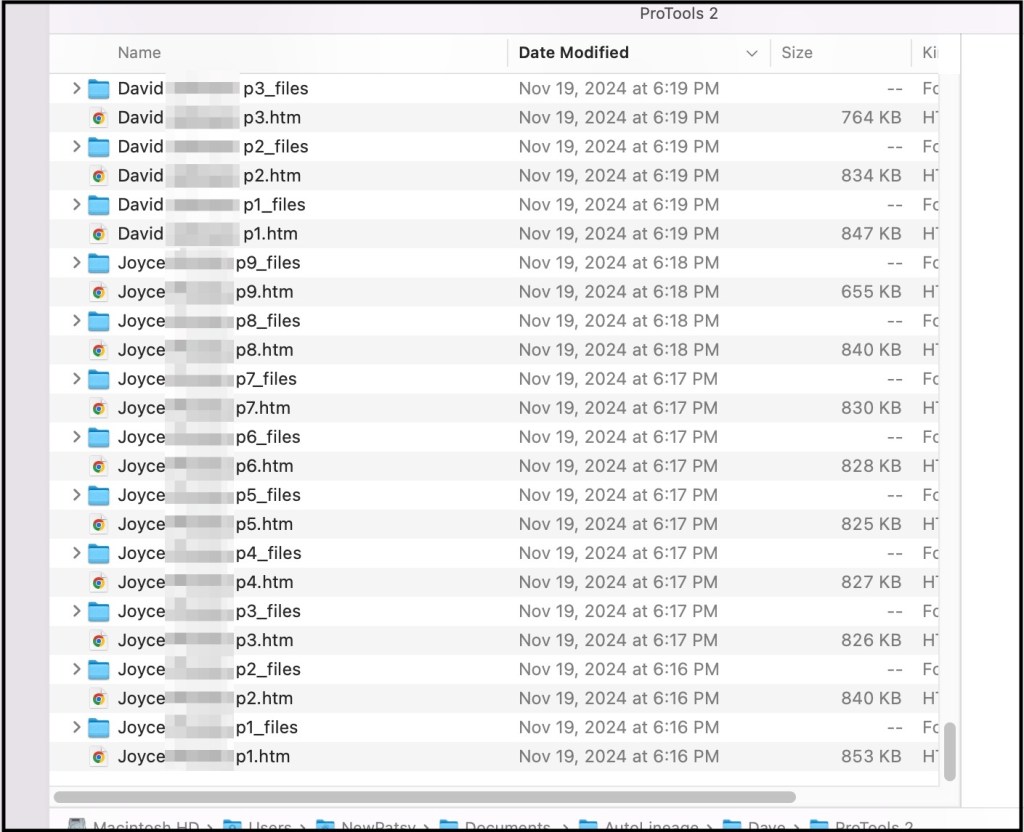
This is especially useful when the match has multiple pages of shared matches. The figure below shows match lists for Joyce, who has nine pages of shared matches and three of the pages of David’s shared matches. With these shared matches it is important to keep the folder as well as htm file that you add to AutoLineage. If you delete the folder, the htm file will also be deleted.
Directory showing some of the files of shared matches.
Tiffany is a match to Dave and she has 6 pages of matches. I start out by saving her first page.
Saving Tiffany’s first page of shared matches.
Before saving the file I copy the match name and p, which I’ll use for all of the matches other pages and just add the page number.
Copying the match’s name and p for the page number.
Then I watch as the circle, that is in the upper right bar of Chrome, fills in around the arrow to make sure that the file has been completely saved
On the left is the circle that is drawn as the file is being saved. On the right is the look after the file is saved.
Once the file is saved I position my mouse next to the arrow and change to the next page. I then leave the mouse there for the rest of the files. I also set my left hand so I can use Command S and Command V for the rest of Tiffany’s pages. I’m on a Mac and Command S saves the page in Chrome and Command V pastes the beginning of the filename that I copied earlier. On a Window computer the commands would be Control S and Control V.
Left hand positioned for Command S.
By just pivoting my fingers I can reach Command V.
Finger pivoted to reach Command V.
Once the file for the first page of Tiffany’s matches is saved, I mouse click to page 2. Then Command S brings up the ‘Save page as’ dialog. Command V copies in Tiffany p. I move my right hand and select 2, to make the file say ‘Tiffany p2’ and use the Return key to save the file. As the files are added to my directory I can see what has already been added which makes it easy to not overwrite a file.
Directory showing the files that have already been saved.
The figure below shows all six pages of Tiffany’s shared matches. The first five pages have twenty matches each and the last page has nine matches. You’ll noticed that all six pages were saved in under two minutes.
Directory showing all six pages of Tiffany’s shared matches.
Summary
I have found this to be a lot faster than having to go up to the File menu to get ‘Save page as’ and also to have to type the filename over each time. I’ve also found several matches with up to fourteen pages of shared matches. Especially when you’re trying to save a lot of shared matches to build out your clusters and subsequently the reconstructed trees, saving any time on the data collection is a bonus.
AutoLineage is a powerful tool that allows you to cluster your matches at a particular testing site but also to find common ancestors across multiple sites. In this blog, we will discuss a scenario when only data from FamilyTreeDNA (FTDNA) and GEDmatch can be used as sources, for instance for an investigative genetic genealogy search.
An example reconstructed tree using only FTDNA and GEDmatch data.
We will be importing and analyzing data from FTDNA and GEDmatch, and use the common ancestor identification tool to find common ancestors. Also, we’ll show how to use the hints tool to get insights about ancestral lines that could hold a potential common ancestor.
AutoLineage Landing Page.
From the landing page select ‘Register a new Profile’ in the left panel. Start AutoLineage by making a profile for the case you are investigating and for whom DNA matches are obtained. In this blog, we shall be using Dave as an example.
Starting a new profile.
Family Tree DNA
Next, a DNA test is registered.
FTDNA selected.
The first thing to do is to import Dave’s matches from FTDNA. Click on the ‘import matches’ button.
Flowchart showing Import matches.
Each testing site has its own list of methods for collecting matches.
Options for uploading matches from FTDNA.
Here we are using the first one, a CSV file from Genetic Affairs. Clicking on the question mark explains what file this option needs.
Explanation of the CSV from Genetic Affairs.
For this option, we first ran the AutoCluster analysis with the AutoTree feature enabled for FTDNA on Genetic Affairs.
Starting AutoCluster with AutoTree enabled on Genetic Affairs.
After starting the analysis, an email appeared with a download link. Alternatively, this link is also available in the notification section on the members page of Genetic Affairs (top right corner, under the bell icon).
After unzipping the results file, we found all the data we needed for AutoLineage. In the Gephi folder, two files are present; nodes.csv and edges.csv. The nodes file contains the matches that would be selected in the dialog box of the ‘Wizard – import matches’.
The imported DNA matches are shown after the import process has been completed.
Dave’s match list from FTDNA.
Clicking on ‘DNA test overview’ at the top brought back the flowchart where we selected ‘Import shared matches.’. Shared matches are required for the clustering process.
Flowchart for Import shared matched.
The wizard explains that the edges.csv file from the Gephi folder is used for the shared matches.
Getting shared matches.
After importing the shared matches, which can take some time, the number of shared matches for each match is now displayed in the table.
Matches list showing the number of shared matches each has.
With matches and shared matches available, we ran the cluster analysis for FTDNA. Going back to the ‘DNA test overview’ brings up the flowchart where we selected ‘Cluster matches.’
Flowchart showing Cluster matches.
The ‘Clustering wizard’ allows us to select the range of matches for the clustering, which type of clustering, and which color scheme should be used.
Cluster wizard.
We selected to run all of Dave’s matches in the clustering analysis. After selecting the “start clustering” button, the clustering chart appears.
FTDNA cluster of all of Dave’s matches.
GEDmatch
For the GEDmatch data, we added data from an AutoKinship analysis (Tier 1).
Setting up AutoKinship on GEDmatch Tier 1 tools.
Going back to Dave’s profile page we registered another DNA test and selected GEDmatch from the drop-down list. Next we ‘import matches.’ An unzipped AutoKinship report also has a Gephi folder containing the nodes.csv and edges.csv files. Nodes.csv contains Dave’s matches, and edges.csv contains the shared matches. Now these matches can be clustered. We ran 500 kits for AutoKinship and 362 of these have shared matches.
GEDmatch Cluster of 362 matches.
Adding Trees
Now it’s time to add trees. The trees are typically associated with the matches, but they are managed independently of the DNA testing site. Clicking on ‘Home’ in the left panel brings up a list that includes ‘Tree Management.’ Clicking on ‘Tree Management’ brings up the flowchart for Trees.
Tree Overview flowchart page.
In ‘Gather Trees’ we clicked on ‘Import Trees’ which brought up the ‘Tree Wizard.’ There is a setting for the trees associated with the GEDmatch DNA matches, and a different setting for trees associated with the FTDNA DNA matches. In both cases, they retrieve tree information from the ‘match’ files associated with the GEDmatch AutoKinship or the FTDNA AutoTree AutoCluster.
‘Import tree wizard’ showing the two options for importing the trees associated with both testing sites.
In both scenarios, we selected all the HTML files in the match folder of the unzipped AutoCluster FTDNA report or unzipped AutoKinship GEDmatch report. Using these methods also ensured that the trees were automatically associated with the FTDNA and GEDmatch DNA matches
The GEDmatch AutoKinship folder contents.The list of trees inside the matches folder.
Typically, iGG profiles are not associated with trees, but in our example, Dave does have a tree, and it needs to be linked to his profile. For other cases where the tester does not have a tree, such as people looking for birth parents, this step would be skipped, and you’d go on to ‘Find Common Ancestor’ from the various DNA matches.
To link Dave’s profile to a tree, we visited the tree management and select Dave in the ‘link profiles to tree’ section (alternatively, go to the tree view in Dave’s profile and associate the tree from there).
Link tree to profile in flowchart.
We clicked on Dave’s name and brought up the Wizard to link Dave’s profile to his tree. Next we searched for Dave’s tree in the name field.
Link profile to tree Wizard.
Selecting Dave brought up his tree where we selected him as the root person of the tree.
Selecting Dave as the root person in his tree.
This brought up Dave’s tree. Notice the person image over Dave’s name that tells the tree is connected to his profile.
Dave’s tree. Names of living persons or those who died since 1973 have been hidden,
Going back to Dave’s profile page we scrolled down to ‘Find Common Ancestors’ near the bottom of the page. There are now two DNA tests associated to his profile, and some of the DNA matches are linked to trees that we imported. We selected the ‘find common ancestor’ button to start the common ancestor wizard.
Find Common Ancestors in the Flowchart.
Running the analysis with the default birth year of 1800 identified eighty-seven common ancestors for Dave across FTDNA and GEDmatch. A problem arises when a match is on both sites and has a tree at both locations. The match on the right of the reconstructed tree shows both FTDNA and GEDmatch. She and her tree are duplicated which causes brown squares, indicating that tree persons are duplicated. Seeing a lot of these brown squares is often indicative of a problem.
DNA match who is on both sites and has trees on both.
Clicking on ‘Linked trees’ shows the trees that are attached.
‘Linked trees’ to Rachel DNA matches.
Right-clicking on the tree brought it up in a new tab. Since the GEDMatch tree has more people we kept that one and deleted the FTDNA one. Next, we attached Rachel’s FTDNA DNA match to the remaining GEDmatch tree.
Connecting Rachel’s FTDNA match to her GEDmatch tree.
Rachel shared 30 cM with Dave at FTDNA and 27.7 cM at GEDmatch. Looking through the list of matches in the Wizard there’s only one Rachel that matches Dave at FTDNA with 30 cM, so we selected that one.
Clicking on the DNA symbol over Rachel’s name shows she is connected to both GEDmatch and FTDNA matches to Dave.
Finding Hints
Since Rachel was the only match on both FTDNA and GEDmatch we used her tree and ‘calculate hints.’
Rachel’s tree.
Calculate hints is basically a common ancestor identification with a focus on the tree that is shown on the screen. The tool compares the names and dates in Rachel’s tree with all the other trees that have been loaded into AutoLineage. It can take a minute or so for this calculation depending on how many trees there are. Contrary to the regular common ancestor tool, the hints tool also shows hints about shared surnames and/or surnames and first names.
Rachel’s tree with hints.
The calculate hints from Rachel’s tree showed a yellow hint for Phyllis May Thompson and for Grace Tonkin. Yellowish hints indicates a shared surname and might mean that there might be something useful farther back in time. So we expanded the tree out first from Phyllis. The common surname, Barrett, was found in another DNA match’s tree, but the dates were several hundred years different. Next we looked at the hint for Grace.
Grace Tonkin hints.
Grace Tonkin’s hint showed that Dave had several people in his tree with the Tonkin surname, but her date is more recent than the people in Dave’s tree. We followed the Tonkin line past Grace in Rachel’s tree and found that Thomas Tonkin’s dates were in the same range as those in Dave’s tree.
Thomas Tonkin hint.
Thomas Tonkin’s wife, Margaret Hattam, also has a hint.
Margaret Hattam in Rachel’s tree.
Looking at Margaret Hattam’s hint we find that Dave’s tree has several Hattam ancestors.
Margaret Hattam hints..
Margaret Hattam was born in 1785 and Dave has an ancestor, Mary Hattam born in 1783. When we added Margaret’s parents to our tree, and rerun the hints tool we found new green hints linked to Margaret’s parents.
John Hattam and Elizabeth Eddy both have green hints.
Looking at John Hattam’s hint we found that he is in both Rachel’s tree and Dave’s tree. We’ve found the common ancestor!
John Hattam in both Rachel’s and Dave’s trees.
Since John Hattam had a birth date of 1754, we changed the birth year to 1700 in the parameter of the ‘Find Common Ancestors’ wizard and then reran ‘Find Common Ancestors.’
Changing the birth year in the Find common ancestor Wizard.
Now a total of fifty-four ancestors were found, and the reconstructed tree showed the connection between Dave and Rachel. They have common fourth great-grandparents, John Hattam and Elizabeth Eddy.
Reconstructed tree connecting Dave’s and Rachel’s trees.
Dave’s tree is showing brown squares which often means there is a duplicate tree or a date problem, however for Dave’s family this is correct. He has two Hocking lines. John Hocking’s parents were James Monteith Hocking and Martha Murrish. James Monteith is one of the Hocking lines, and Martha’s mother was Eliza Hocking, which is the other Hocking line. They both go back to John Hattam and Elizabeth Eddy, so they are Dave’s fourth great-grandparents twice!
Summary
We ran AutoLineage using only FTDNA and GEDmatch data to look for common ancestors to Dave and his matches. AutoLineage generated clusters for the FTDNA matches and also for the GEDmatch matches. Trees from both testing sites were loaded and attached to the DNA matches. Next, we identified common ancestors across all of the data. We found one match who had a tree on both sites. By associating her DNA from both sites to one tree and deleting the extra tree we avoided her showing as a common ancestor to herself. Next, we ran hints on her tree to get clues on which ancestral lines to prioritize for our research. After expanding the tree, and re-running the hints tool, we found the common ancestor. This led us to find that she and Dave had common fourth great-grandparents!