Recently MyHeritage announced some new, additional Theories of Family Relativity. Theories are similar to Through Lines on Ancestry, but they show all the pieces of the different trees that are used for the Theory. In a way that makes it a bit like a Quick & Dirty (Q&D) tree, only I didn’t have to make it myself. What I like to do is to use documented records to verify the matches’ trees, and then add the matches’ DNA segments to DNA Painter profile. This lets me look for shared segments from different Theories and hopefully find more family connections. At first I was only going to add the Theories that I could verify as being correct. But then I decided that adding the incorrect ones as well and looking for shared segments might make it possible to find the correct connection.
My family is small, and I only had one new Theory. Besides, I know how all six of the Theories fit into my family. So it’s not particularly exciting. My husband, Dave, on the other hand, had a lot of new Theories bringing his total to sixty-six. Dave’s one of seven and three of his sisters have done DNA tests, plus a number of his nieces have as well. But there are still sixty Theories that are not close family. What kind of new information could I find for his family by looking at these Theories?
Starting with one of the Theories I looked at what was proposed as the connection and most recent common ancestor (MRCA). Dave’s highest match was ‘Carol.’1

I found different resources were used for each of the three Theories for Carol’s relationship to Dave. The first used my Coleman tree and Carol’s tree. The second added the 1880 Federal Census, and the third added two other families trees besides Carol’s and mine. All three of them reached the same conclusion. The MRCA couple was Jacob Marti and Anna Fritz. The Marti family is Dave’s paternal grandmother’s side.
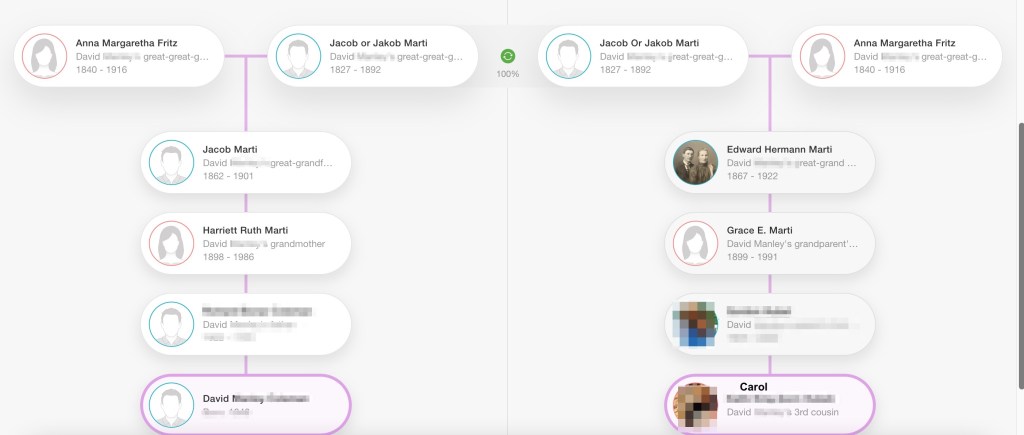
Dave’s paternal grandmother was Harriett Ruth Marti. Looking at her family tree, figure 3, we see that Jacob Marti and Anna Fritz were Dave’s second great grandparents. The Marti family originated from Switzerland and settled in Michigan after immigrating to the United States.

One way to view the results of the MyHeritage ‘Theories’ is by making a profile for Theories in DNA Painter. Copying the DNA segments that Dave and Carol share from MyHeritage, figure 4, and then putting them into DNA Painter provides a way to collect all these data, but also to analyse the matches.

In a new profile in DNA Painter Carol’s data is pasted into the “Paint a Match’ box, figure 5.

Her data was entered into a new group named for Dave’s second great grandparents, Jacob Marti & Anna Fritz. The resulting profile is shown in figure 6.

I continued going through the Theories adding the matches to the DNA Painter profile.
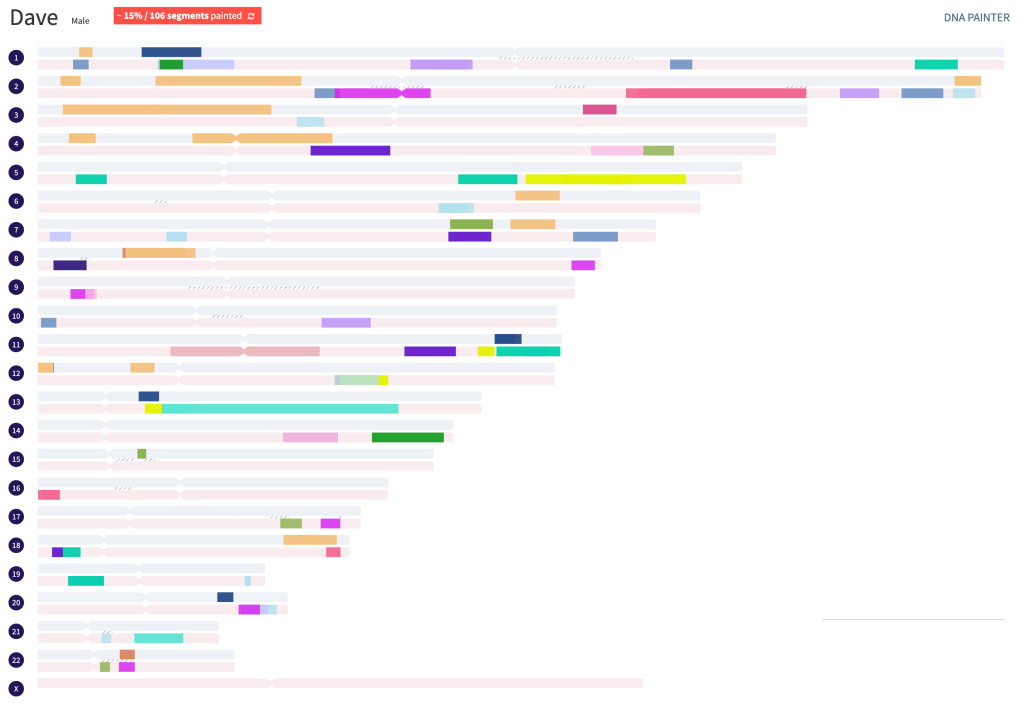
Looking closely at Dave’s DNA Painter Profile from the Theories there’s no DNA segment overlap for his paternal matches, but several maternal matches do overlap. On chromosome 11 there’s overlap with Kelly and Frank, see figure 8. There’s also a clear recombination point between Andy and Kelly.

The MRCA for Sue are Haken Nisson and Cajsa Andersdotter, Dave’s third great grandparents. The MRCA for Andy are Anders Salonomsson and Kerstin Andersdotter, Dave’s fourth great-grandparents, who are the parents of Cajsa Andersdotter. Kelly’s MRCA with Dave are Peter Kilts Graves and Lucy An Shear, his third great-grandparents. Frank’s MRCA with Dave are Smith Shear and Martha Handy, his fourth great grandparents, who are the parents of Lucy An Shear. Because of the overlap with Kelly and Frank the entire segment that Kelly has must have come from either Smith Shear or Martha Handy. Since any one segment can only come from one person Kelly’s segment would have come to her from Lucy An Shear from Lucy’s parents.
Many of the Theories are for Dave’s maternal side. His mother’s maiden name was Hocking. The Hocking family were miners in the Cornwall region of England. By the middle of the nineteenth century mining in Cornwall was declining and many miners emigrated to Australia to mine gold, to South Africa to mine diamonds, and to the United States to mine iron. Dave’s great-grandfather, James Monteith Hocking, Sr., was living in Mesabi Mountain Township in the city of Eveleth, Minnesota in the 1905 state census. Dave’s maternal side has two Hocking lines. James Monteith Hocking, Sr. wife was Martha Murris, whose mother was Eliza Hocking. ‘Mary’ was one of the first Hocking matches we found when Dave did his DNA test. Her great-grandfather, John Hocking, emigrated to New Zealand around 1879. The DNA connection to Mary is on the Eliza Hocking line with their MRCA being Dave’s fifth great-grandparents Simon Hocking and Jane Lutey, see Figure 9.
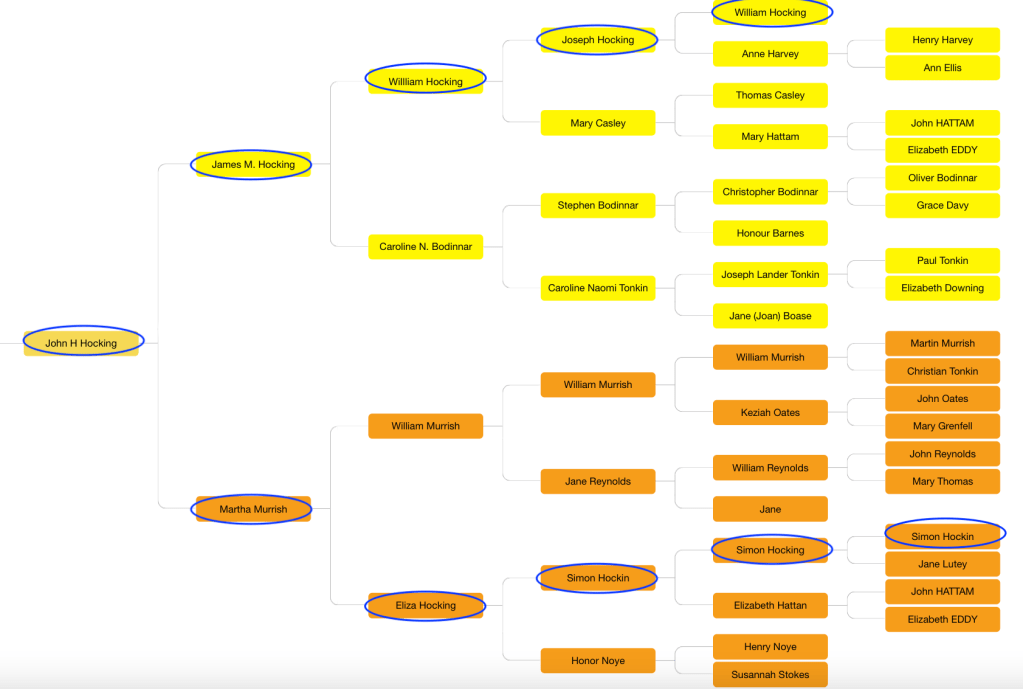
The Hocking Descendant Society Inc. is based in Australia but has members from all over the world. They have done a great deal of research backing up Hocking families with records: birth, baptism, marriage, death, burial, and census records.. A lot of the information for Dave’s tree came from them, tracing back both of his Hocking lines.
On chromosome 20 Dave triangulates with Mary, Kay, and Rachel, as shown in figure 10. Mary and Kay are sisters and Rachel is their niece. They also triangulate with Kate, whose Theory has a wrong set of parents in her Hocking line. However, because of the triangulation she would need to be somewhere on this Simon Hocking and Jane Lutey line to Dave.

On chromosome 1 Mary overlaps with Matt, see figure 11.
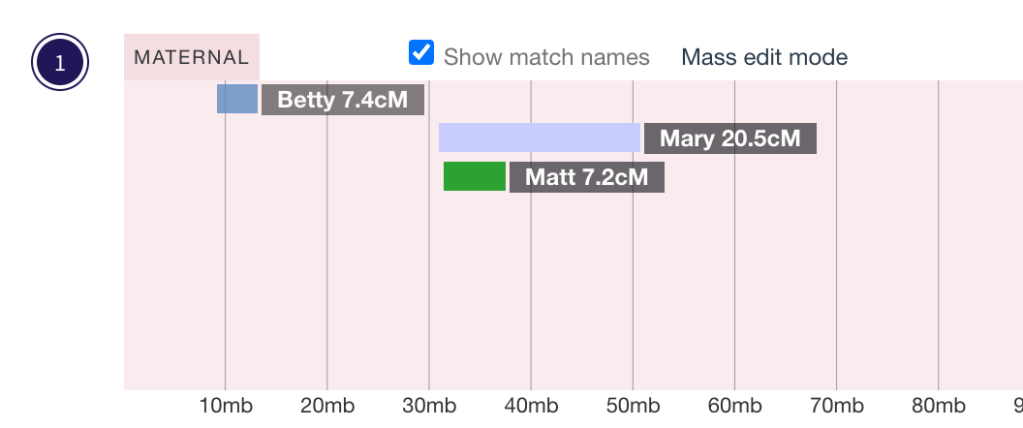
Matt was adopted, but he knows that his paternal great-grandmother was Elizabeth Hill Hocking. Perhaps there’s a clue here! Matt’s segment here is only 7.2 cM, and I know there’s a fifty percent chance that a 7 cM segment is a false match. But looking at that differently there’s a fifty percent chance that it is a true match. Matt has another segment on chromosome 14 that’s 32.6 cM. Looking at some more of the shared matches that Matt has with Dave on MyHeritage I find that Matt and Dave triangulate with Dave’s first cousin once removed, Jean. Jean is the granddaughter of James Monteith Hocking and Martha Murrish.

Adding this information it now appears that Matt’s great-grandmother, Elizabeth Hill Hocking, should be somewhere in the Hocking family line between Dave’s great-grandparents, James Monteith Hocking and Martha Murrish, and his fifth great-grandparents, Simon Hocking and Jane Lutey. Time to go back to the documents from the Hocking Descendant Society and also search British and Australian records to search for Elizabeth’s location in this line.
Summary
MyHeritage Theories of Family Relativity provides a path that connects the DNA match and the tester and shows the various trees that were used to find the MRCA. There are links to all these trees which makes it easy to check what information they have. It’s a bit like having Quick and Dirty trees provided for you! Of course, you need to still verify the information with documented records.
Putting the segment data from Theories into a DNA Painter profile makes it easy to see if there is segment overlap between people in different Theories. When there is, check the shared matches one of them in MyHeritage to see if they triangulate with the tester. If they do this would indicate a MRCA. Then searching documented records could help you place them correctly in your tree.
- All names of living DNA matches are fictitious.
 Patricia Coleman Genealogy LLC
Leave a comment